Companies of all sizes struggle with late or failed payments, which typically require some form of exception handling to fix. According to Coface’s 2025 UK Payment Survey, 90% of businesses experienced issues with late payments in the past year, and the average payment delay stands at 32 days. The problem is getting worse, with nearly half (44%) reporting that delays are more frequent than before.
Dealing with late or failed payments costs time, money and potentially business opportunities. For example, financial planning can be disrupted because of a late or failed payment, resulting in a cash shortfall and revenue leakage. This, in turn, impacts investment plans and potentially the degree and cost of borrowing within the business.
Late Payment Costs Add Up
The administrative costs associated with failed or late payments are often substantial. This can be illustrated using Direct Debits, with a 2.3% average failure rate according to Office for National Statistics (ONS) data as of October 2025 and an average reported transaction value of £314.
For a company that receives one million Direct Debits, with an estimated £50 administration cost per failed transaction, this amounts to £7 million in failed or late payments and over £1 million in admin costs.
In Bottomline’s recent webinar, ‘No More Manual Mayhem’, a straw poll of the audience found that the biggest challenge for most respondents (67%) is the manual effort it takes to resolve a late or failed payment.
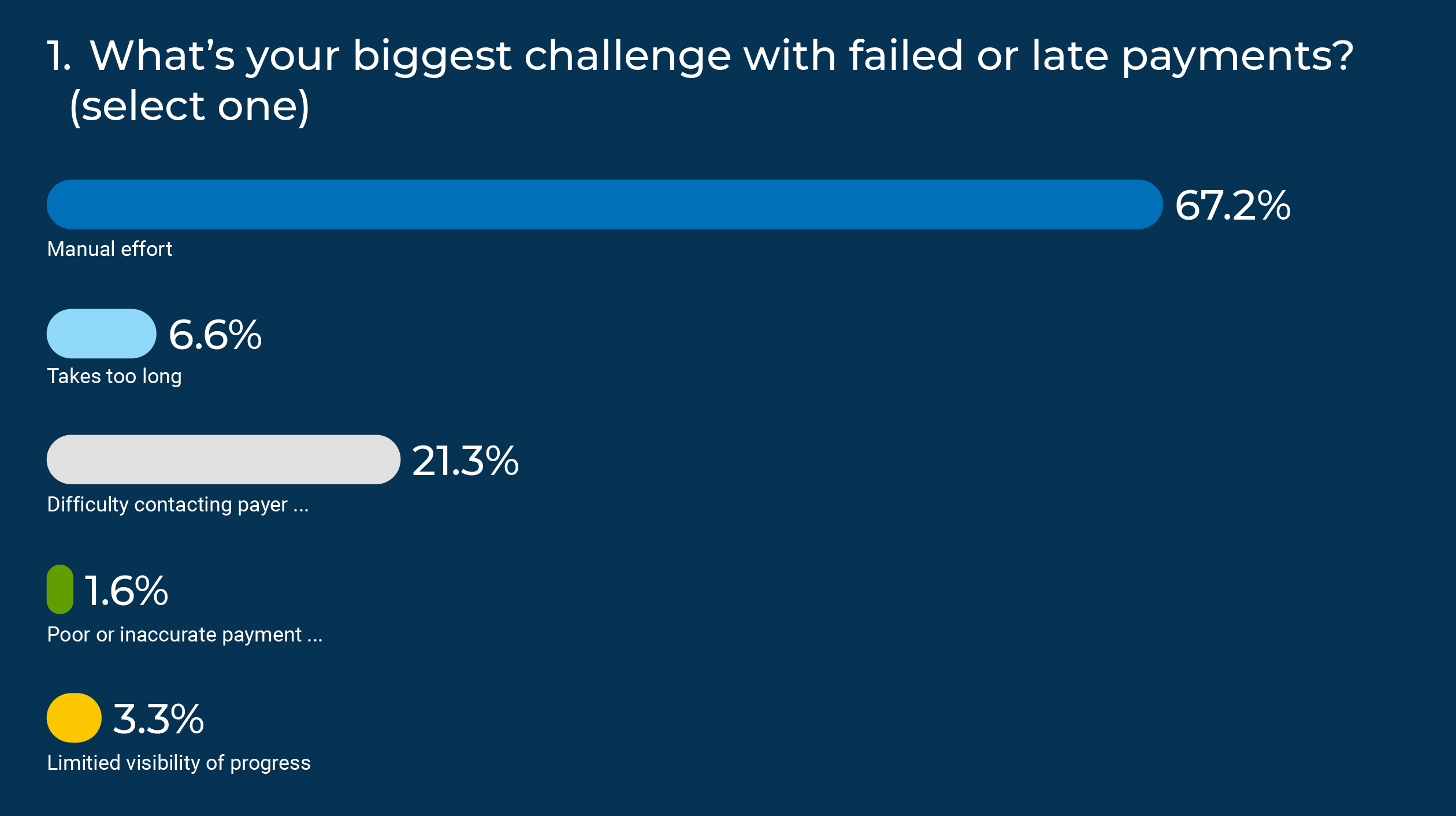
Manual handling of exceptions and fragmented processes can lead to inefficiencies and an increased number of late payments. As exceptions can occur at any stage in the Direct Debit lifecycle, resources can easily become overwhelmed, especially as organisations begin to scale their processing volumes. Additionally, fragmented processes and handoffs can also create gaps, making the business less resilient.
Ultimately, organisations need to evaluate the level of fragmentation and manual intervention in their recovery process. Specialised platforms can help companies unify and automate the workflows, remove manual steps and maintain data accuracy.
But businesses need to take action to tackle the problem; the longer these issues go unresolved, the greater the impact on cash flow, operational effort and customer relationships. In fact, ONS data indicates a historical trend of increasing Direct Debit failure rates. This should be a wake-up call, particularly for those businesses providing discretionary services in the B2C space.
This segment experiences higher failure rates than essential services in times of economic difficulty, as payers prioritise critical expenses such as mortgage and utility payments.
Response Speed Matters
A missed or failed payment isn’t necessarily late, but becomes so when the exception sits idle. Manual processes, spreadsheets, batching and various gaps compound to turn an outstanding payment into a late one. And evidence suggests the longer that the exception remains idle, the later it becomes and the more difficult it is to recover.
Another poll during the webinar found that 4 in 10 businesses take one to two days to react to an overdue or failed payment, while 30% can take up to a week. Only 18% react within a day.
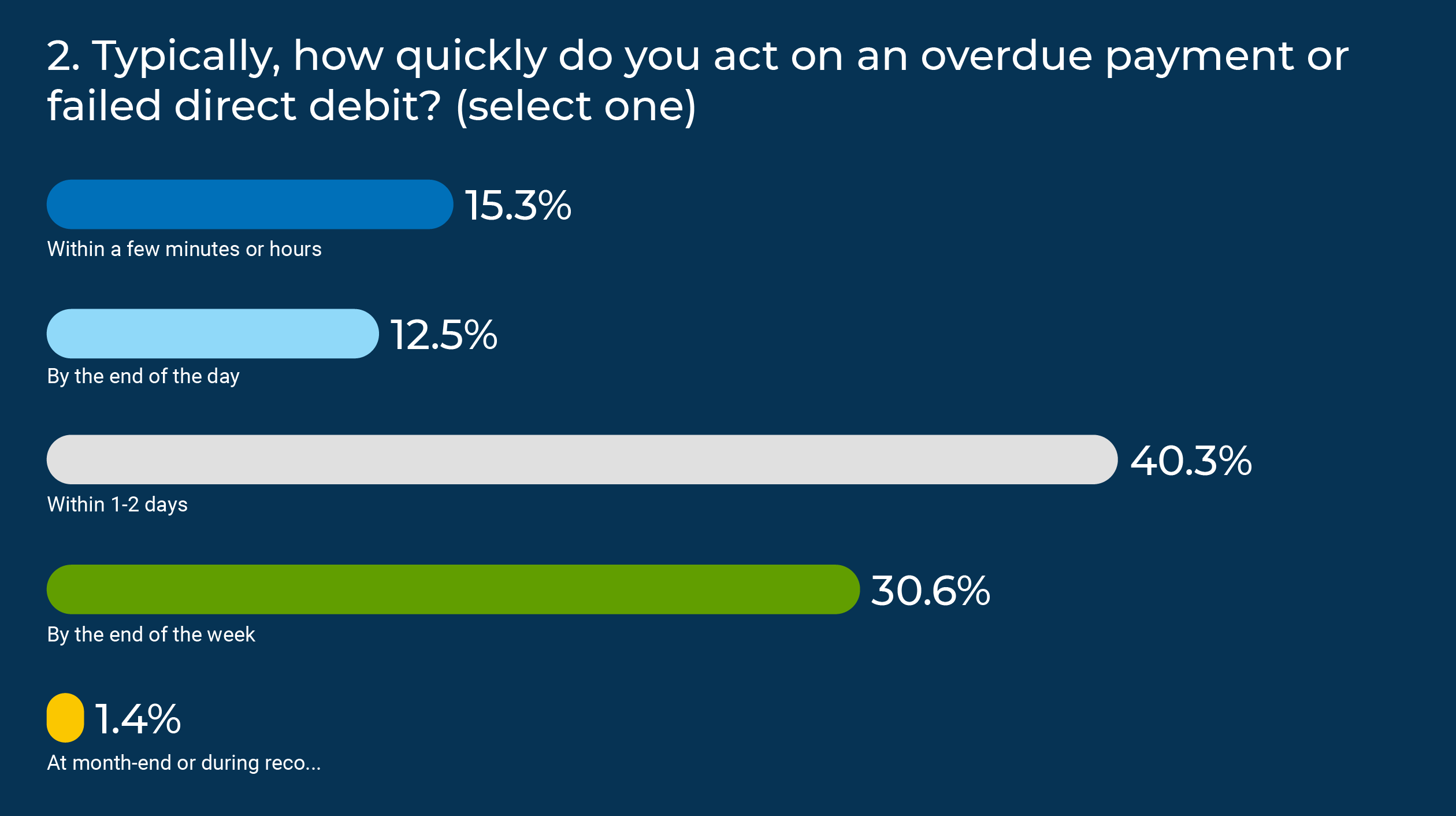
What does a good response timeframe look like? Ideally, ‘as soon as possible’ is where businesses want to land. Clearly, there are trade-offs between real-time exception processing and batch processing efficiencies.
Up to a week may be acceptable for some organisations but not for others, as some will need access to cash as quickly as possible; others won’t.
But all businesses need to respond promptly when a Direct Debit fails, as a slow response could result in a business missing the retry cut-off deadline under the Bacs scheme, allowing a business only one month to follow up after the failure date.
If that window closes, then the business will need to look at a new payment arrangement, such as a new Direct Debit request or an alternative payment method. In either scenario, the recovery time and cost will increase.
In addition, failure to follow the Bacs guidelines pertaining to chasing failed collections can leave an organisation exposed to indemnity claims. The payer has the right to request a refund under the Direct Debit Guarantee, which is unlimited by time and value. That, in itself, can present additional financial admin challenges and costs.
To improve response speed and reduce risk, businesses should focus on:
- Up-to-date data: Processing account change reports and ensuring they are fed automatically into the exception processes
- Bank account validation: Every business should be using Pay.UK’s Confirmation of Payer and Payee, which has 99.9% UK account coverage for both business and consumer accounts, to ensure the right data from the outset. Businesses should reconfirm payer details periodically throughout the relationship.
- Accelerating the rate of exceptions handling: Integrate Bacs error reports directly into the process. As soon as a failure code is identified in the error report, the fact that it’s ingested and part of the process means it can be responded to immediately, eliminating delays and the risk of the exception being missed.
Alternative Payment Choices
Another audience poll found that getting the payment collected after a Direct Debit failure was the biggest process bottleneck for 68% of respondents.
The issue often isn’t whether people will pay, it’s whether they engage at all. Research shows many consumers avoid dealing with financial issues altogether (MX, 2025), while one in five people in debt say they dread hearing from creditors (Money and Mental Health Policy Institute, 2023). When things escalate, that lack of engagement only deepens.
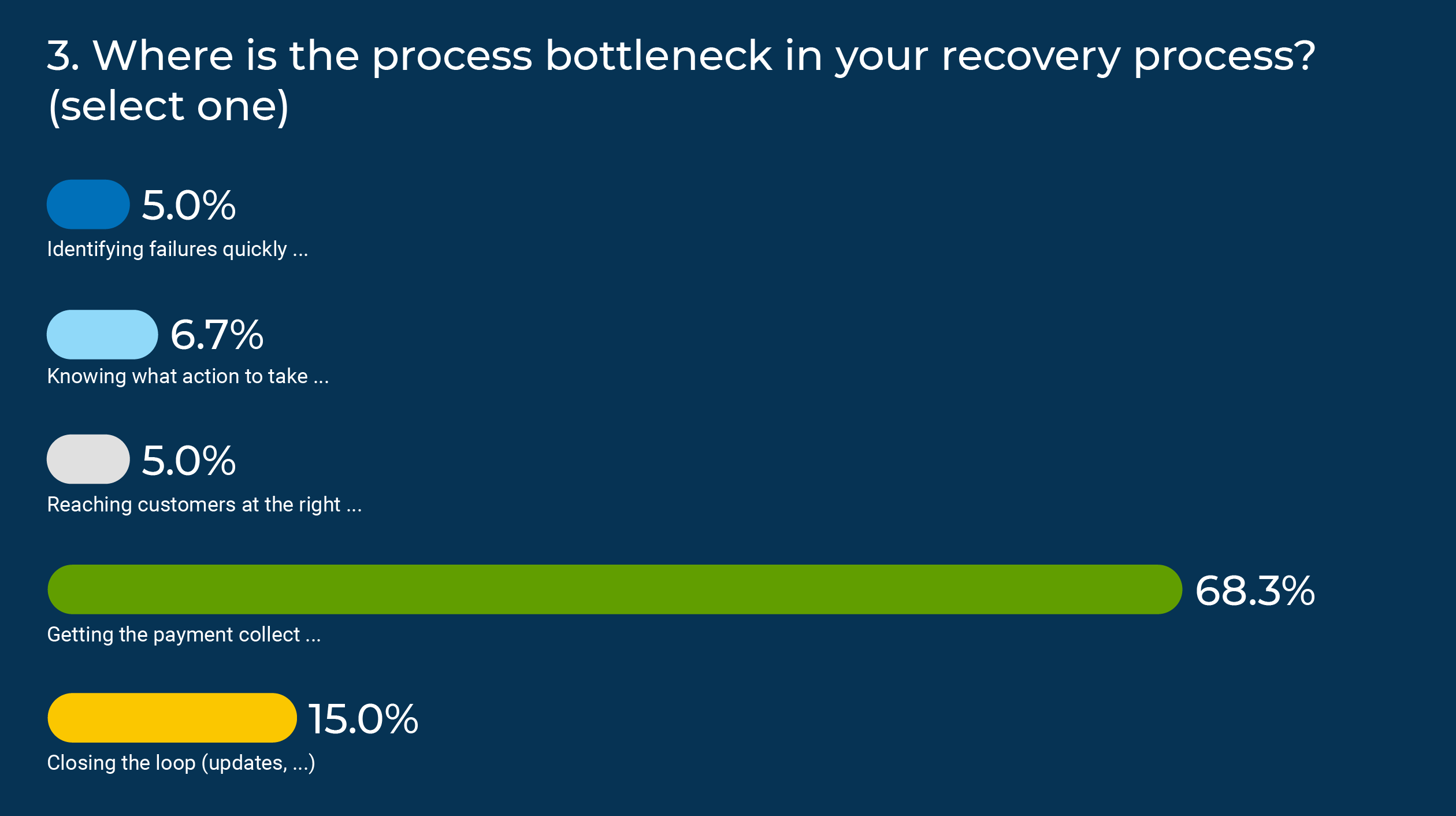
Removing the need for direct engagement makes the process easier for the payer and reduces the cost and effort for the business. Instead of retrying a failed Direct Debit, businesses can offer alternative payment methods to suit the customer and keep the experience as frictionless as possible. Timeliness, convenience and choice combine to make a successful outcome more likely.
For example, a payment link is a secure, single-use link which includes pre-loaded payment and reference information, simply requiring the payer to complete the payment. It saves the recipient time, maintains data integrity, and reduces the risk of keying errors, such as reference information and amounts. Typically, links are generated via application programming interfaces (APIs) or file upload for an invoice run.
Bottomline, for example, has integrated payment links directly into its Direct Debit exceptions workflow. When a payment fails, a link can be automatically generated and distributed. Alternatively, payment links can be sent via email or SMS or converted into a QR code and added to printed or PDF invoices, allowing customers to complete payment quickly using a smartphone.
Customers can choose to pay using Pay by Bank, a secure Open Banking-powered payment method, or by card. Providing choice increases convenience and improves the likelihood of successful payment completion.
Beyond resolving a missed payment, the same approach can also be used to shape future behaviour. Bottomline has created the ability to generate links for new Direct Debit sign-ups, allowing a business to add a QR code to an invoice or statement and encourage the payer to set up a recurring mandate for future payments.
The link can also be used to generate a replacement mandate when an error response indicates a cancelled mandate. In this scenario, the business could send two links: one to set up a replacement mandate, and the other to immediately collect the outstanding payment.
Overall, the aim is to inject alternative payment methods into existing business flows, systems and processes, making it easier to recover missed payments while reducing the likelihood of future failures.
Automation is Key
To remove friction, fragmentation, manual steps and delays, businesses need an exception-to-recovery process that moves quickly and accurately. Such a process helps free up finance teams to do higher-value work, as they spend less time on admin tasks, such as payment rerouting, and integrate updates into workflows.
Most importantly, organisations need to ensure they have clear oversight of the complete receivables operation. Bringing each step into a smooth, continuous cycle of recovery will be better all-around for the business, customer relationships, and the payer’s experience.
Small changes in these areas can significantly improve the collections process, without requiring major investment or business transformation.
A good exceptions management process includes:
- Faster exception‑to‑recovery cycles
- Reduced manual effort with straight-through processing (STP)
- Intelligent workflows
- Immediate “pay‑now” alternatives via payment links
- Better auditability and control across receivables operations
Summary
Failures are an inevitable part of recurring business payments. But the manual mayhem that often surrounds recovering them doesn’t have to be.
By streamlining fragmented processes, reducing manual effort, and offering convenient payment options, businesses can reduce the disruption caused by failed payments and significantly improve recovery rates.
Share