AI can flag unusual payment amounts, timing or frequency that are difficult to recognize at scale.
A payment can be properly formatted, properly approved, and still be alarmingly wrong. A beneficiary is changed. An amount is out of character. The account raises a sanctions flag. Or a transaction that looks perfectly ordinary on its own makes no sense compared with the hundreds of payments that came before it.
That is perhaps the primary control problem finance teams are confronting in 2026.
Faster payments, more banks, more cross-border activity and greater automation have expanded the places where bad data, fraud or simple human error can get into workflows. Waiting for the bank to catch the problem at the other end is too late. The better opportunity is identifying risk while a corporate still has time to stop money from moving.
AI has a star turn in that role, but not because payments need another layer of technology for technology’s sake. Its value is in spotting what rules and human reviewers too often miss, at scale, while stronger beneficiary validation, sanctions screening and workflow controls give organizations useful tools to act on those signals.
In the webinar, “Control, Compliance and AI in Payments,” Richard Ransom, Head of Solutions Consulting for Corporates at Bottomline, and Phil Malone, Product Director with Bottomline’s Global Payment Hub product team explored how organizations are putting advanced capabilities to work without sacrificing operational control.
Yesterday’s Controls Aren’t Good Enough
Many payment processes were built around threats finance teams already understood. But as payment volumes, fraud techniques and operating models change, controls that worked five or ten years ago can lose effectiveness.
Ransom said those established processes “probably are in need of a refresh” and urged organizations to revisit the controls they already have.
The warning applies beyond easy to spot fraud attempts. It applies most to things that often look ‘normal’ on the surface. A changed supplier account, an unusual payment time or a sudden increase in payment frequency may each appear legitimate on their own. The challenge is recognizing when ordinary-looking activity becomes extraordinary in context.
That’s why modern payment controls need to operate throughout the payment lifecycle, from beneficiary creation through approval and release. Bottomline’s Global Payment Hub supports that flow with managed host-to-host connections, Swift and local clearing, ERP integrations and multiple payment formats. Ransom summed it up simply, saying, “we’re managing bank connections so you don’t have to.”
Audience Poll
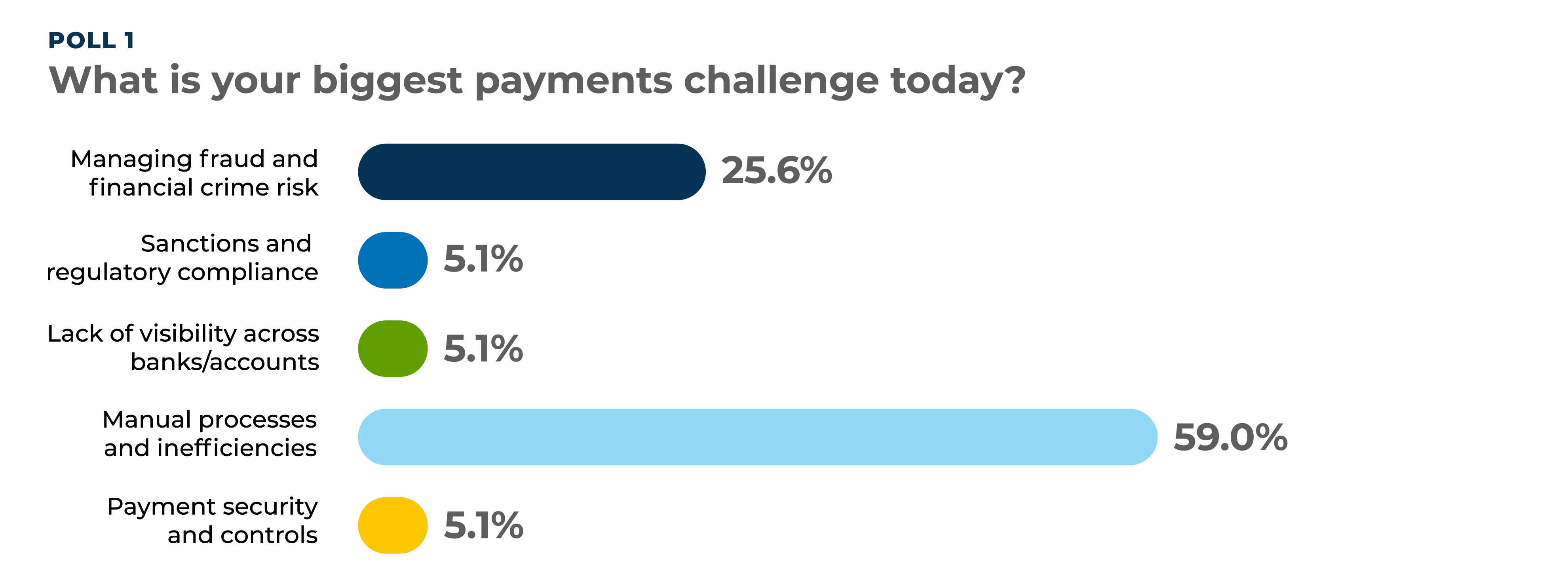
Protecting the Beneficiary
Account details often reside across ERPs, billing systems, spreadsheets and applications never designed as secure repositories for sensitive bank information. Within Global Payment Hub, tokenization reduces that exposure by storing account details outside host systems and replacing them with a token until submission.
Regulation is doing its part too, with some countries pulling ahead of the pack. The UK is a prime example with its Confirmation of Payee (CoP) protocol adding another line of defense by checking if beneficiary name and account details match before funds move. Similarly, the EU has its Verification of Payee (VoP) standard handling pre-validation.
Pre-validation is crucial because redirecting a legitimate payment can be as simple as changing valid vendor information. Ransom said CoP has likely “stopped a large amount of authorized push payment fraud [and] invoice fraud in business” since its 2020 inception.
That value extends beyond fraud prevention. Better beneficiary validation can catch errors sooner, reduce rejected payments, and limit repair work after something has gone wrong.
Move Sanctions Checks Closer to the Payment
Banks will continue to screen transactions, but discovering a problem only after a payment reaches the bank leaves corporates with fewer options.
In this instance, a solution like Global Payment Hub brings sanctions screening alongside beneficiary validation and payment workflow, giving organizations time to investigate possible matches before release. As Malone explained, “We can stop the payment until somebody takes action” and decides to proceed, or not.
The ‘so what’ is having control at the moment it matters most. Instead of treating sanctions screening as a downstream banking issue, corporates can investigate and resolve a potential problem while they still control the payment.
AI Finds the Payment that Doesn’t Belong
Traditional rules remain useful, but Global Payment Hub’s anomaly detection capability can identify behavior that differs from established patterns. That might include an unusual payment amount, activity outside normal operating hours or a supplier suddenly being paid far more frequently than usual.
One payment may not look suspicious. Its relationship to hundreds of others may tell a different story. A series of smaller payments can equal big fraud yet not trip legacy alarms. And the risk isn’t limited to deliberate fraud. Ransom noted that “we talk about fraud a lot, but errors can be as costly.”
That makes anomaly detection an operational control as much as a fraud control. Catching the wrong amount, beneficiary or transaction before release can protect working capital, reduce rework and avoid damage to supplier relationships.
Audience Poll
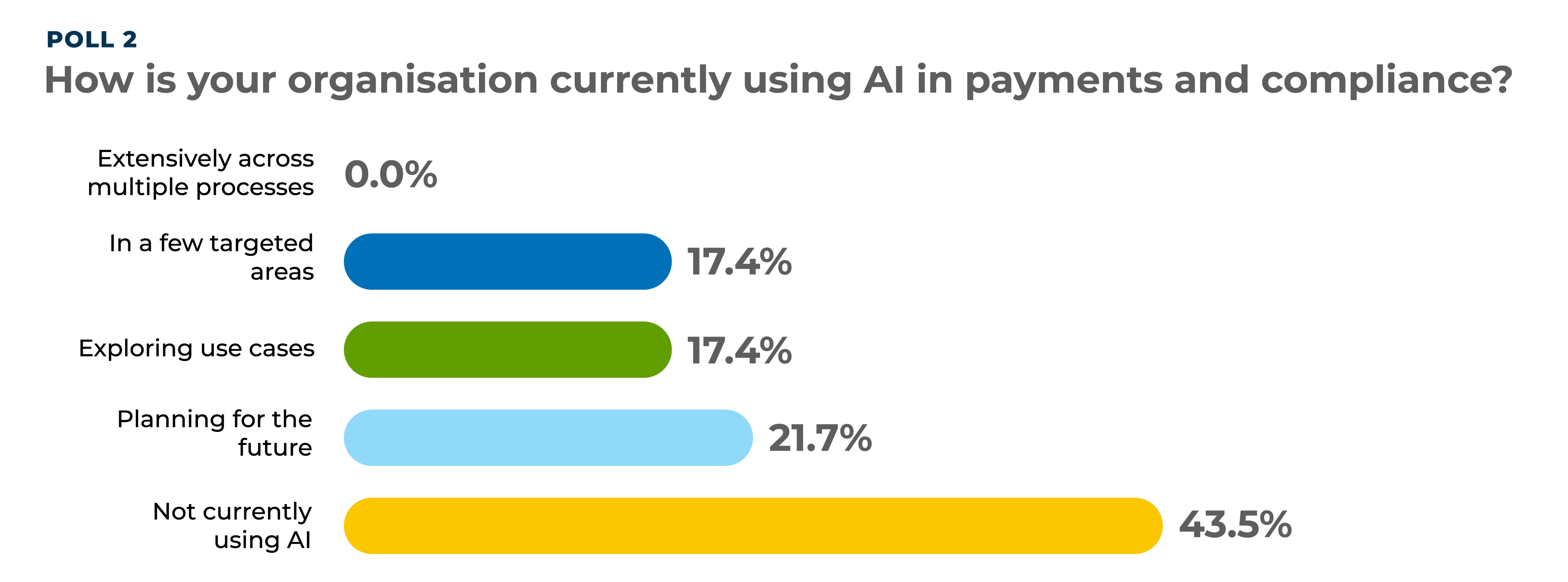
AI Is Coming Down to Use Cases
Finance leaders are interested in AI, but many are still determining where it produces measurable value in payments.
Malone described the situation candidly, saying many companies simply “don’t know what they don’t know” and are looking for guidance on where AI can address payment problems. That uncertainty can be useful if it prevents organizations from deploying AI prematurely.
Payments offer plenty of use cases for AI, from anomaly detection to conversational AI agents like the one built into Global Payment Hub. It helps users find accounts, check payment status, and navigate workflow documentation.
But the strongest applications solve a defined operational or risk problem.
Ransom offered a useful standard for separating genuine value from AI as shiny new object: “The problems have to be real, and the solutions have to really help. It shouldn’t just be used for the sake of it.”
That principle also guides the next phase of payment modernization. The objective is not to make payments more “AI-powered.” It’s to make suspicious transactions easier to identify, sensitive information harder to compromise, compliance problems easier to intercept, and B2B payment operations easier to control.
Watch the full webinar: Control, Compliance and AI in Payments
FAQs
How can AI improve payment security?
How does Confirmation of Payee help prevent payment fraud?
CoP checks beneficiary account information against the account name to detect mismatches before release.
Why should corporates conduct sanctions screening before sending payments to banks?
Earlier screening gives organizations greater control before a potentially problematic transaction reaches the bank.
What does account tokenization do?
Tokenization replaces sensitive bank details in host systems with a token, reducing stored account information.
Share