Cash management in higher education is a growing challenge. Delayed tuition payments, fluctuating enrollments, and rising operational costs demand smarter financial strategies. Increasingly, institutions are looking to technology, including AI, to help them maintain liquidity, optimize workflows, and deliver exceptional student experiences without compromising financial stability.
How are treasury professionals in higher ed using artificial intelligence (AI)? And what’s driving that adoption?
The Cash Management in an AI World survey was designed to assess these very questions. It garners responses from over 250 treasury professionals across a myriad of industries, including commercial real estate, manufacturing, healthcare, transportation and logistics, and warehousing. This blog delves into the survey results for respondents who practice treasury at institutions of higher education.
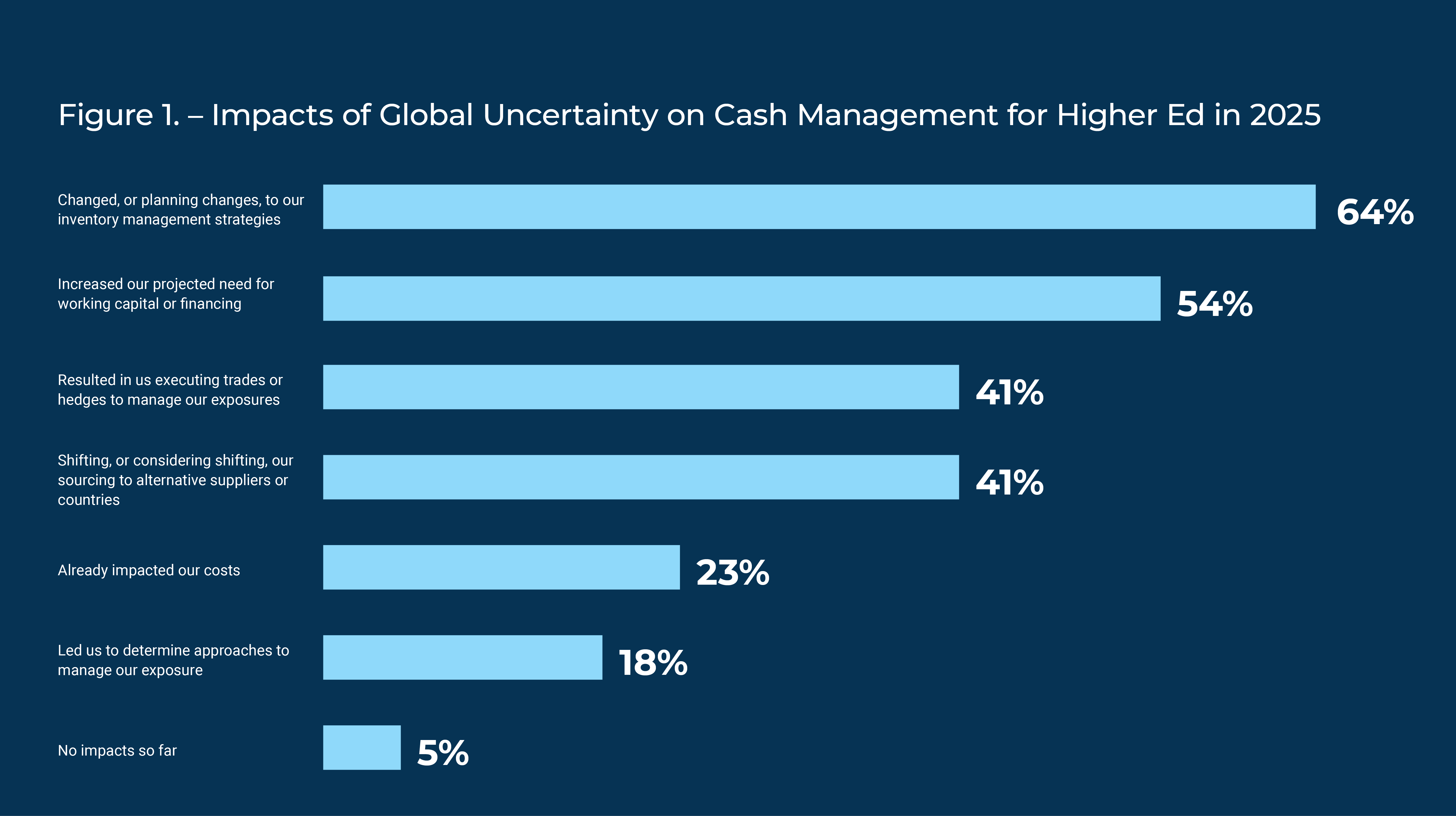
Those who work in higher education have changed how they identify and manage risk exposures, adjust supply chain strategies, and experience cost increases (see Figure 1).
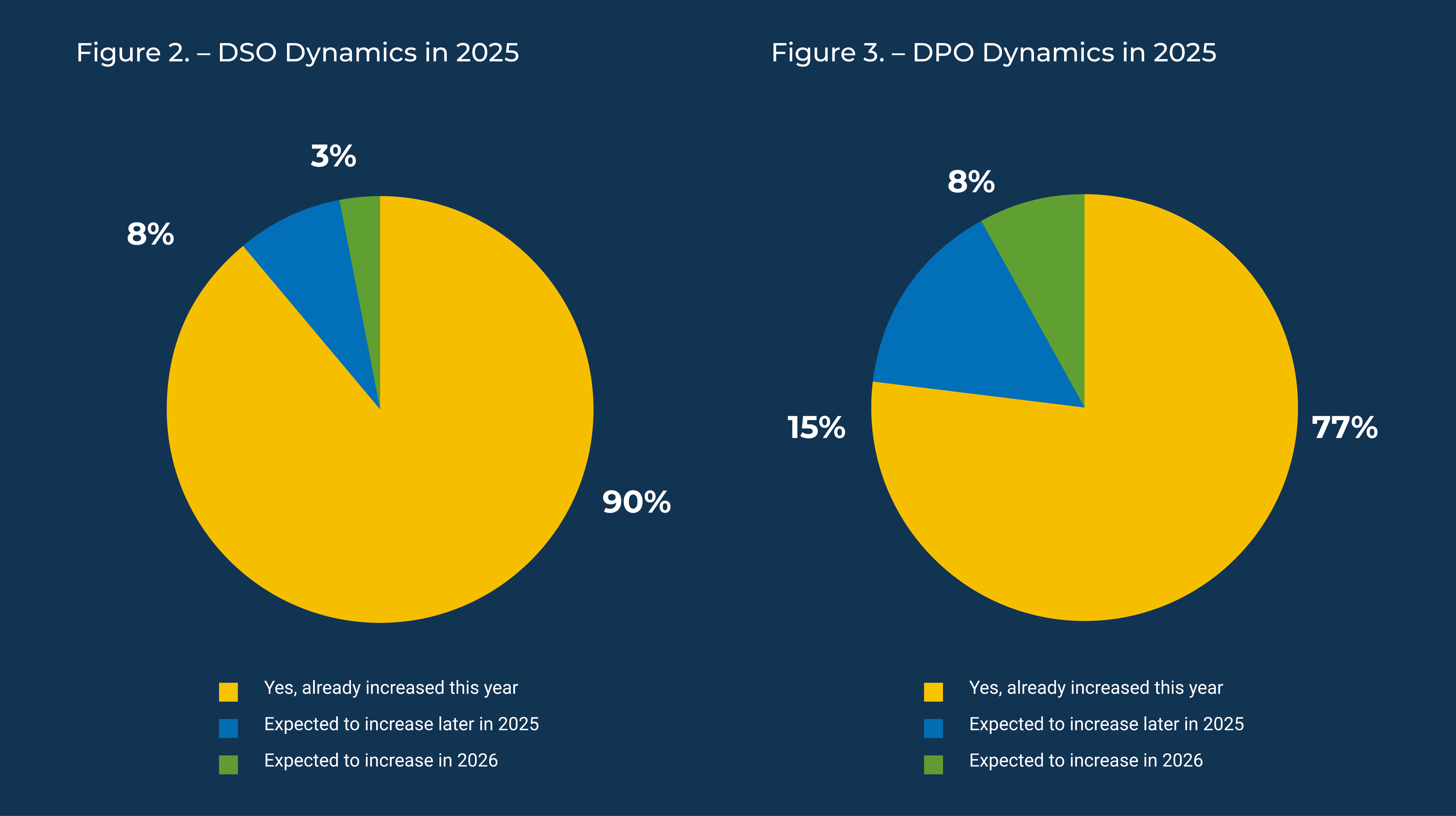
The impacts of 2025’s economic volatility on cash management include increases in both Days Sales Outstanding (DSO) and Days Payable Outstanding (DPO) (see Figures 2 and 3). These datapoints suggest that making data-driven decisions around cash movement is more important than ever.
Figure 2: Days Sales Outstanding Trends in Higher Education Treasury, 2025.
Figure 3: Days Payable Outstanding trends in Higher Education Treasury, 2025.
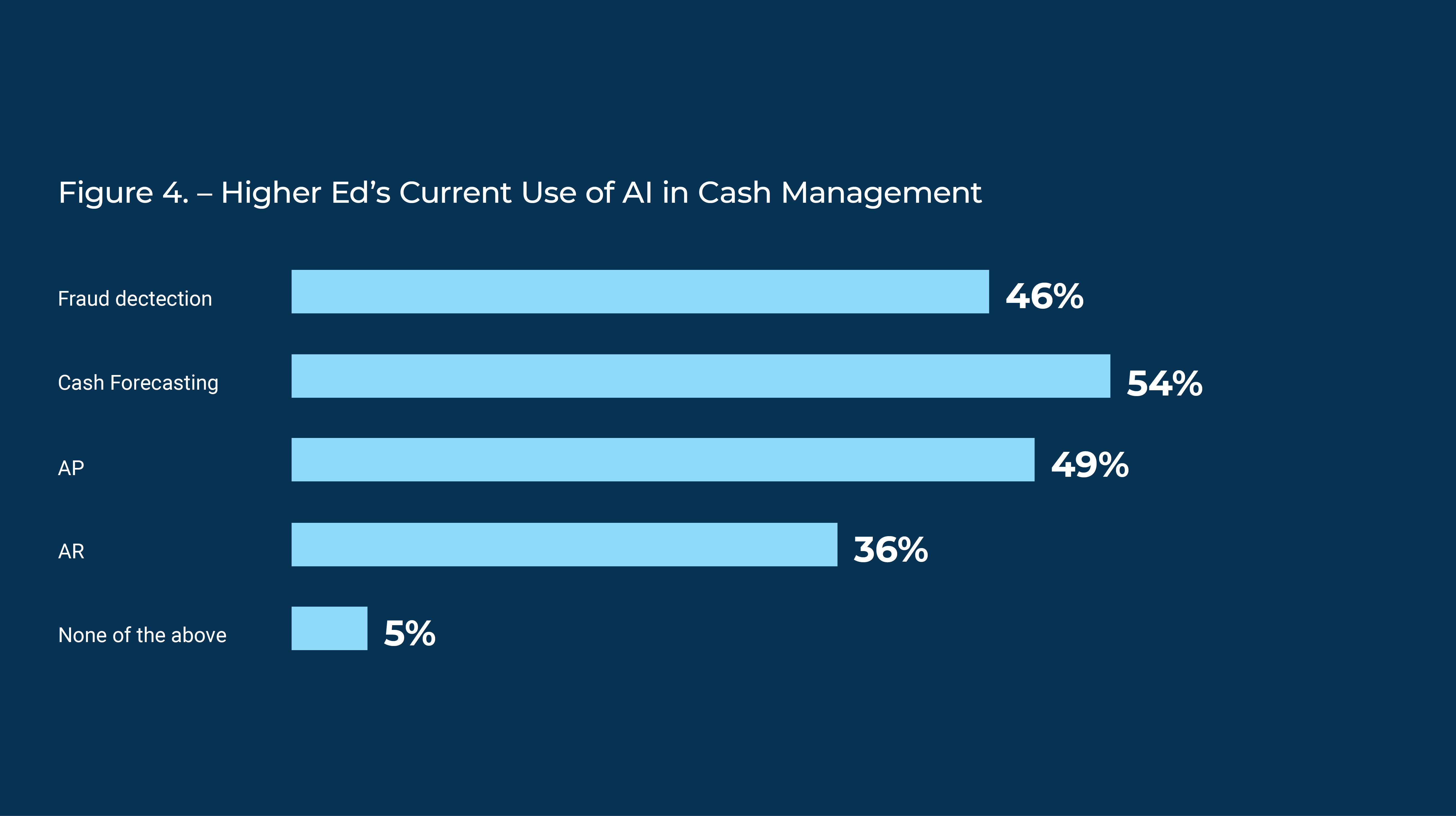
Institutions of higher education are leveraging AI across many areas of cash management. Among survey respondents, 36% represent higher education institutions. Within this group, adoption is highest in cash forecasting (54%), followed by accounts payable (49%), fraud detection (46%), and accounts receivable (36%).
This broader adoption of AI in cash management, beyond cash forecasting, reflects the fact that treasury teams often have direct control over AP and AR. Cash forecasting success depends on how well cash inflows and cash outflows are understood and predicted, so leveraging AI across cash forecasting, AP, and AR makes sense.
Figure 4: Higher Ed’s Current Use of AI in Cash Management
Why are respondents in higher education leveraging AI in treasury? The answer lies in the challenges treasury teams are trying to solve.
The most common cash management challenges faced by treasury teams are regulations, a lack of visibility into bank account activity, a lack of collaboration among AP and AR, and a lack of cash forecasting speed. Investing in AI in treasury for fraud detection, AP, AR, and cash forecasting can help companies mitigate these challenges.
AI Adoption in Higher Ed Treasury
- Treasury teams at higher education institutions have less control and influence over accounts payable than those at commercial real estate, manufacturing, and healthcare companies.
- Increases in DSO were more prevalent in 2025 at higher education institutions than at commercial real estate, manufacturing, and healthcare companies.
- The use of spreadsheets as the primary cash management tool is more prevalent in higher education institutions than in commercial real estate, manufacturing, and healthcare companies.
- The strategic role of treasury is more likely to increase at institutions of higher education than at commercial real estate, manufacturing, and healthcare companies.
Survey Insights: Key Takeaways
- Unprecedented global market dynamics in 2025 increased DSO and DPO at companies of all sizes across diverse industries.
- Top cash management challenges are unanticipated changes in regulatory, limited cash visibility, and a lack of collaboration between treasury teams, AP, and AR.
- To more effectively manage cash, treasury teams should identify and mitigate cash management silos within their own teams, between AP and treasury, and between AR and treasury.
- AI adoption in treasury is common for cash forecasting, fraud prevention, AP, and AR.
- Key objectives for the adoption of treasury-related technology in 2025 and 2026 are increasing security and control around financial processes, gaining better visibility into key data to improve decision making, and automating manual/repetitive tasks.
- To support treasury teams, companies are investing in technology training, business partnering, and upgrades to cash management, data management, and data analysis technology.
- Many companies expect to add treasury staff in 2026, despite increased AI adoption in treasury.
Next Steps for Treasury Leaders
- Invest in treasury technology and training.
- Address silos between treasury, AP, and AR by implementing solutions that improve cash flow visibility and foster collaboration. By breaking down barriers and enabling real-time access to key financial data, treasury teams can make more informed, agile decisions to navigate economic volatility.
- Dedicate resources to initiatives that increase security, control, and automation of financial processes.
Download the full white paper for benchmarks and actionable strategies.
Share